
Types of Live Coral and Where Each One Belongs
Updated: Aug 21
A reef tank is not one habitat. It is a stack of them, running from a bright, turbulent zone at the top of the rock down to a shaded, slow pocket near the sand, and the types of live coral you can keep depend on which of those zones you are filling. Most losses we see in Chicagoland tanks are not disease. They are placement errors, with a coral that wanted shade cooking under a light or a colony that wanted flow sitting in a dead spot. Here is how the main groups differ and where each one belongs.
The four groups that cover most types of live coral
The hobby sorts corals into four practical groups: soft corals, LPS, SPS and non-photosynthetic species. Those labels are not strict taxonomy, but they predict care better than family names do, because they track skeleton structure and feeding strategy. Large polyp stony and small polyp stony corals both build calcium carbonate skeletons and consume alkalinity as they grow. Soft corals bend in the current and consume far less. Non-photosynthetic corals build in either style but eat rather than photosynthesize.
Soft corals: moderate light, moderate flow, lower third of the rock
LPS: moderate light, gentle indirect flow, mid rock or sand with spacing
SPS: strong light, strong turbulent flow, upper third of the tank
Non-photosynthetic: shade, high flow, and frequent target feeding
Light is food for most of these animals. Photosynthetic corals host symbiotic algae called zooxanthellae in their tissue, and those algae supply a large share of the coral's energy in exchange for shelter. That is why placement height matters as much as fixture wattage, and why moving a colony two inches up the rock can change its color and growth within weeks. Stability beats intensity in every group; a coral adapts to steady conditions and struggles under swinging ones.
Soft corals sit low, take moderate light and forgive mistakes
This group covers leathers such as Sarcophyton and Sinularia, mushrooms including Discosoma and Rhodactis, zoanthids, green star polyp, Xenia and Kenya tree. None of them lays down a rigid skeleton, so they sway with the current and tolerate a wider range of conditions than stony corals do. They are the group we point new reefkeepers toward, and our roundup of corals that hold up for beginners covers the same ground in more depth.
Placement is forgiving but not arbitrary. Most soft corals do well in the lower or middle third of the rock under moderate light and moderate, variable flow. Leathers periodically shed a waxy surface film and close up for a day or two while they do it, which alarms owners and is entirely normal. Running activated carbon during a shedding cycle keeps the water clear and reduces the chemical load on neighbors sharing the tank.
Two cautions belong with this group. Green star polyp and Xenia spread aggressively across rock and glass, so give them an isolated island rather than a foothold on the main structure. Zoanthids and especially Palythoa can carry palytoxin in their slime, which is worth taking seriously: wear gloves and eye protection when fragging or scraping them, keep the work wet, and never boil or dry-scrub rock carrying them indoors.
LPS corals want open space and gentler flow
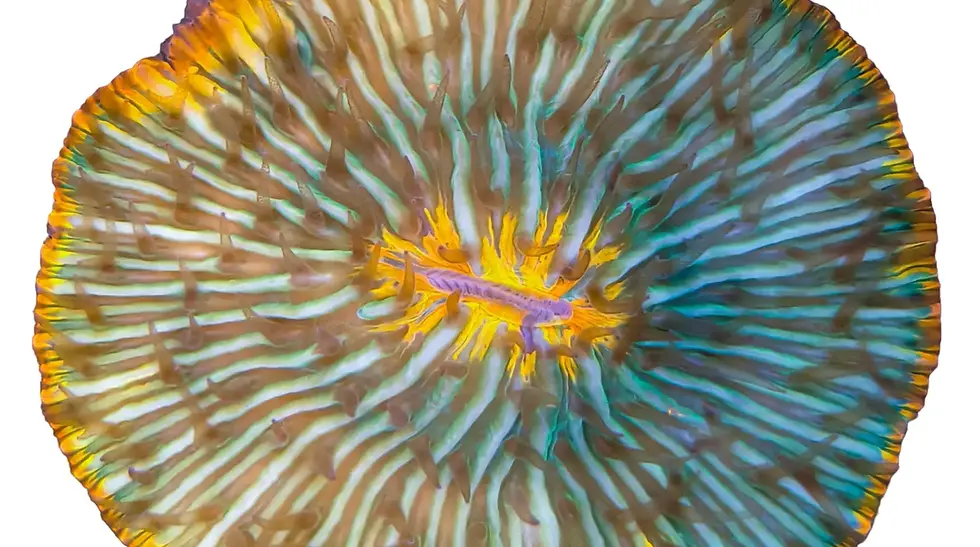
Large polyp stony corals are the showpiece group in most home reefs. Euphyllia species cover hammer, torch and frogspawn corals, and alongside them sit Duncanopsammia, Acanthastrea, Micromussa, Favia, Plerogyra bubble coral and Trachyphyllia. Their polyps are large and fleshy, they inflate over a hard skeleton during the day, and their movement in the current is a large part of why people put a reef in a living room in the first place.
Flow is the detail people get wrong. LPS want indirect, moderate current that lets tissue inflate fully; too much and the polyps stay retracted, too little and detritus settles on the flesh. Light in the moderate range suits most of them, mid rock or sand rather than the top. Trachyphyllia and Cynarina belong on the sand bed, where their skeleton sits naturally. Many species send out sweeper tentacles several inches at night, so leave a real gap between colonies.
Feeding and chemistry finish the picture. Most LPS respond well to small meaty foods a couple of times a week, offered after the polyps have opened. Alkalinity stability matters more than the exact number, though 8 to 11 dKH is the usual working range. A sharp alkalinity swing shows up as tissue recession within days. If you are weighing this group against the faster-growing stonies, our comparison of LPS and SPS corals in Chicago homes is the place to start.
SPS corals demand light, flow and stable chemistry
Small polyp stony corals include Acropora, Montipora in plating and encrusting forms, Seriatopora birdsnest, Stylophora and Pocillopora. The polyps are tiny, the skeletons are dense, and the growth can be fast once a colony is settled. They also punish instability harder than anything else in the tank, which is why we usually suggest a system runs for six months or more before an owner starts adding them.
Placement sits in the upper third of the rock under strong light and strong, turbulent, randomized flow that keeps detritus off the branches. Acclimate new frags to light gradually, starting them lower and raising intensity or position over several weeks, since a colony moved straight under a bright fixture will bleach. Flow should shift direction rather than blast from one point, because a constant jet strips tissue on the side it hits.
Chemistry is where this group lives or dies. Typical working targets are alkalinity 8 to 11 dKH, calcium 400 to 450 ppm, magnesium 1300 to 1400 ppm, salinity 1.024 to 1.026 specific gravity and a steady temperature. Nutrients should be low but never zero; nitrate around 2 to 10 ppm and phosphate around 0.03 to 0.10 ppm keeps color without starving tissue. Rapid tissue necrosis usually traces back to a swing rather than a pathogen.
Non-photosynthetic types of live coral are a feeding commitment
The fourth group hosts no symbiotic algae at all. Tubastraea sun coral, Dendronephthya, chili coral and many gorgonians feed entirely on what drifts past them, which inverts the usual advice: light is irrelevant, food is everything. Sun coral is the most commonly kept of these and the most realistic starting point, since its large polyps can be target fed individually and it visibly responds to a syringe within minutes.
Placement follows the food rather than the lamp. Shaded overhangs, the undersides of ledges and the back wall all work, provided flow is strong enough to keep particles moving past the polyps. Feeding happens several times a week at minimum, often in the evening when polyps extend, and each polyp needs to actually take food rather than simply being sprayed near it. Many keepers feed sun coral inside a cut bottle or a feeding chamber to concentrate the meal.
Be honest with yourself about the nutrient load before buying. All that food raises nitrate and phosphate, so this group demands skimming, mechanical filtration you clean often, and water changes on a schedule you keep. Dendronephthya in particular has a poor long-term record in home tanks and is best left alone. Livestock changes constantly, so call the shop to confirm what has come in before making the drive.
Key takeaways
The four practical types of live coral are soft, LPS, SPS and non-photosynthetic, and each wants a different zone.
Soft corals sit low under moderate light and flow, and forgive the mistakes new reefkeepers make.
LPS need indirect flow, open spacing for night-time sweeper tentacles, and stable alkalinity.
SPS belong in the upper third under strong turbulent flow, with tight chemistry and gradual light acclimation.
Non-photosynthetic corals need shade, food several times a week, and the filtration to handle the waste.
Frequently asked questions
Which types of live coral suit a first reef tank?
Start with soft corals and hardy LPS. Leathers, mushrooms, zoanthids, green star polyp and Duncanopsammia all tolerate the parameter drift a new system goes through while its owner learns to test and dose. Leave Acropora and any non-photosynthetic species until the tank has run stably for several months.
How much space should I leave between colonies?
More than looks necessary on the day. Several inches is a sensible minimum, and Euphyllia species need considerably more because their sweeper tentacles extend at night and sting whatever they reach. Plan for the size a colony will be in a year rather than the frag in your hand, since moving a settled coral sets it back.
Can soft corals and SPS share one tank?
They can, with management. Soft corals release compounds that inhibit stony coral growth, so run activated carbon, keep up water changes and avoid crowding the two groups together. The bigger practical conflict is nutrients, since soft corals tolerate richer water than most Acropora colors prefer. Many mixed reefs work; they simply need attention.
Work with Marine Concepts Inc
Tell us the tank, the lighting and the flow you are working with, and we will help you build a stock list that suits those zones instead of fighting them. You can see what we keep and how to visit us on our local aquarium shop page, and corals, frags and reef supplies are available for same-day pickup at Marine Concept Supply in Wheeling, IL. Call ahead to confirm current livestock.


Comments