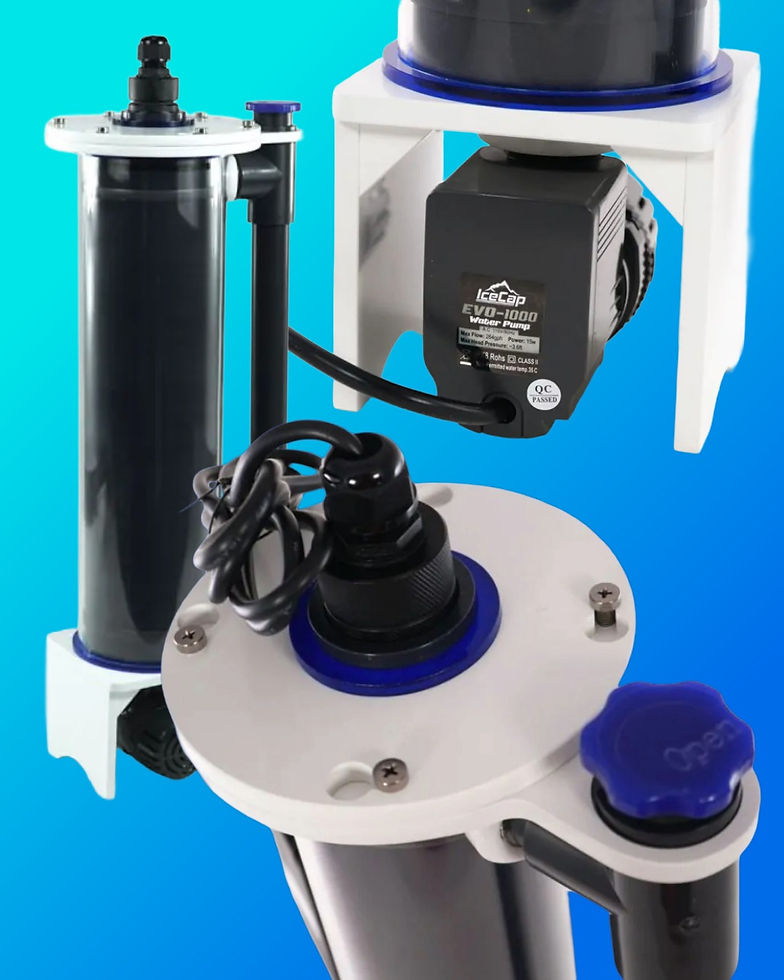
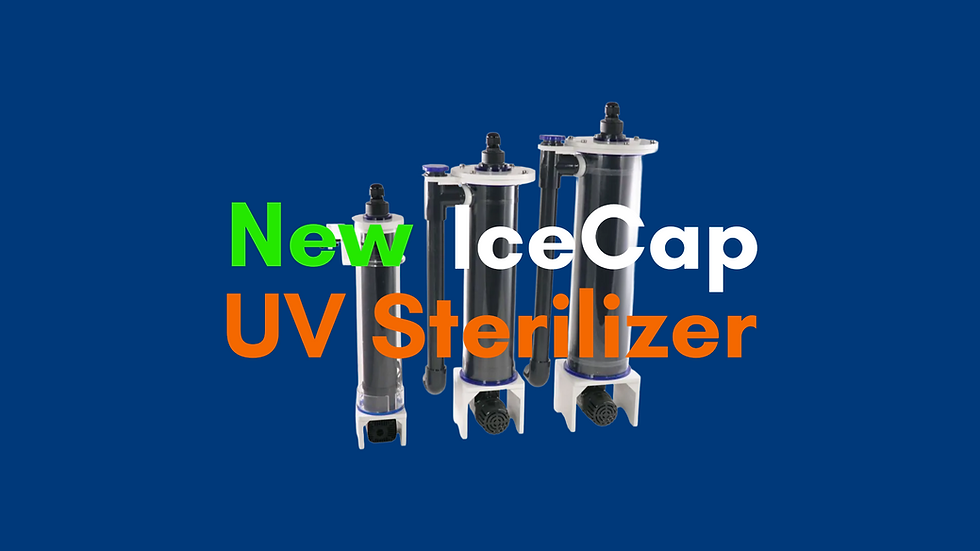
IceCap UV In-Sump Sterilizer: When It's Worth It
Updated: Aug 21
An in-sump UV sterilizer is one of the few pieces of aquarium equipment that does exactly one job, and it does that job only to the water you push through it. The IceCap unit puts the lamp inside the sump rather than hanging a canister off the back of the cabinet, which is a real advantage in a crowded stand. Before you buy one, be clear about what a UV sterilizer fixes, what it leaves untouched, and how much of its performance rides on the flow rate you feed it. We service these on Chicagoland systems every month, and the pattern is consistent.
What a UV sterilizer actually kills, and what it leaves alone
Ultraviolet sterilization works on one narrow principle. Water is pushed through a chamber holding a UV-C lamp behind a quartz sleeve, and organisms suspended in that water absorb enough radiation to damage their DNA and stop them reproducing. The dose depends on lamp output and how long the water stays in the chamber, which is why two identical units give different results on two tanks. Nothing living on the rock, the sand or the fish ever sees the lamp; only the water routed through the housing is treated.
That narrow principle still covers a useful list. Free-floating bacteria, the single-celled algae that turn water green, fungal spores and the free-swimming stages of several parasites all spend part of their life cycle in open water where a lamp can reach them. Thinning that population lowers the number of encounters between a pathogen and a fish, and it clears suspended algae faster than anything short of a full blackout. Clarity usually improves within a few days.
What it will not do matters just as much. Ultraviolet does not touch parasites already attached to a fish or encysted in the substrate, so it slows an outbreak rather than ending one. It removes no nitrate and no phosphate, and it does nothing about algae growing across rock and glass, because that film never travels through the chamber; that problem is answered by the nutrient and husbandry side of algae control instead. An overfed tank generates problems faster than any lamp clears them.
Where an in-sump unit earns its space in the cabinet
The systems that benefit most carry heavy fish loads and gain new arrivals often. A large fish-only display, a mixed community that adds a fish every few weeks, or several tanks sharing one sump all move pathogens around efficiently, and a lamp running full time gives a standing reduction in what circulates. Retail and holding systems run them for that reason, and so do many of the commercial installs we maintain, where a visible outbreak is a business problem as much as a livestock one.
Cloudy water is the other clear case. A bacterial bloom after a new setup, a relocation or a heavy feeding will usually clear on its own, but a lamp shortens that from weeks to days. Green water in an indoor pond or a bright freshwater tank responds faster still, since free-floating algae is the easiest target ultraviolet has. If a system has just been moved, running the unit while the biology settles is a sensible temporary use.
Some tanks do not justify it. A lightly stocked mature reef with disciplined quarantine, stable parameters and no history of disease gains very little, and the same money buys better test kits or a proper quarantine tank. Ultraviolet is a risk-reduction layer sitting on top of good husbandry, never a substitute for it. Anyone describing a UV sterilizer as insurance against disease is overselling what a lamp in a housing can do.

Flow rate decides whether a UV sterilizer works at all
Every unit carries a published maximum flow for each job it is rated to do, and those numbers are not interchangeable. Push water through too quickly and each organism receives a fraction of the dose it needs; run it too slowly and you treat a trickle while the rest of the system circulates untouched. The manufacturer's figures are the ones to trust, because they are tied to that lamp's output and that chamber's volume. Watts-per-gallon rules of thumb ignore both.
The rough hierarchy is easy to remember. Algae dies at the lowest dose, bacteria needs more, and parasites need considerably more than either. That is why one housing is often rated for a much larger tank for clarification than for pathogen control, and why you should decide which job you are buying it for before setting the flow. Most home systems pass roughly one to three display volumes per hour through the unit, but check that against the specification rather than treating it as a target.
Feed the unit from its own small pump instead of teeing off the return line. A dedicated feed lets you set flow precisely, and a clogged sterilizer can never starve the display. Fit a valve on the discharge side to throttle it, verify the real rate with a measured container and a stopwatch, then check it again a few months later. Biofilm inside the housing and a dirty impeller both cut flow quietly.
Plumbing an in-sump lamp without upsetting the rest of the sump
Draw the feed from a chamber where water has already passed through mechanical filtration. Suspended detritus absorbs and scatters ultraviolet, so dirty water receives a lower effective dose even when the flow rate is set correctly. That single decision does more for real performance than buying a larger unit. Keep the intake off the floor of the chamber so it is not pulling settled sludge, and clear of the skimmer's turbulence, where microbubbles collect inside the housing.
Return the treated water to a different chamber than the one you drew from. If the outlet discharges beside the inlet, the same water loops through the lamp repeatedly while the display never sees it, and the unit looks like it is working while achieving almost nothing. Unions on both sides turn servicing into a two-minute job rather than a wet afternoon. Leave clearance to lift the assembly out without draining the sump.
Electrical discipline matters more here than with most equipment. Run the unit on a GFCI circuit, build a drip loop into every cord, and keep the ballast or driver above the waterline and out of the splash zone. UV-C burns skin and eyes, so the lamp never gets energized outside its housing, not even briefly to confirm it lights. A submerged unit also adds a little heat to the sump, worth accounting for on a system that already runs warm in summer.
Bulb life and sleeve care keep the dose honest
A UV-C lamp keeps glowing long after it has stopped delivering a useful dose. Germicidal output decays steadily through the lamp's service life, and the visible blue glow comes from a different part of the spectrum, so a lit lamp proves nothing. Manufacturers generally specify replacement somewhere between six and twelve months of continuous operation; follow the figure for your unit rather than waiting for a failure that never visibly arrives. Write the install date on tape stuck to the housing.
Film, coralline or mineral scale on the quartz sleeve blocks light before it reaches the water, and a badly fouled sleeve costs more output than an aging lamp does. Clean it with a soft cloth and a dilute vinegar soak, never an abrasive pad, and handle the glass with a cloth so skin oils do not bake on. Spare lamps and sleeves are worth having before you need them, and you can check availability through Marine Concept Supply.
Unplug the unit and let the lamp cool before opening anything.
Close the valves, break the unions and lift the housing clear.
Withdraw the lamp, remove the sleeve and soak it until the film releases.
Inspect every O-ring and wipe the seats clean before reseating them.
Reassemble, restore flow, confirm the rate, then energize the lamp last.
Most stocked systems run the lamp continuously, and that is our default on a commercial install or a heavily populated fish tank. Seasonal use is defensible on a quieter tank, provided you treat it as a response to a bloom or a move. Either way, maintenance is what makes the equipment real. A sterilizer carrying a four-year-old lamp behind a crusted sleeve is an expensive pump accessory and nothing more.
Key takeaways
A UV sterilizer only treats water flowing through the chamber; nothing on the rock, sand or fish is affected.
It thins free-floating bacteria, algae and some parasite stages, but never removes nutrients or cures an attached infection.
Flow rate sets the dose, and the ratings for clarification, bacteria and parasite control are three different numbers.
Take the feed from filtered water and return it to a different chamber than the intake.
Lamp output fades long before the lamp dies, and a fouled sleeve wastes more output than an old bulb.
Frequently asked questions
Will a UV sterilizer cure ich in my display tank?
It will not, and treating it as a cure costs fish. Ultraviolet only reaches the free-swimming stage passing through the chamber, while attached and encysted stages continue untouched. It can reduce reinfection pressure alongside proper treatment, but a quarantine tank and an appropriate therapy remain the reliable route.
Does a UV sterilizer harm the beneficial bacteria in my filter?
Not meaningfully. Nitrifying bacteria live on surfaces, colonizing rock, sand and media rather than drifting in the water column, so very few ever pass through the lamp. Established systems run ultraviolet for years with no measurable change in ammonia or nitrite processing. The biological filter is not what is at risk.
Should the lamp run all the time or only during an outbreak?
Both approaches work if you are consistent. Continuous operation suits heavily stocked or commercial systems where new pathogens arrive regularly. Occasional use suits a quiet, mature tank, switched on after a move or a bloom. What does not work is a lamp left running for years without a bulb change.
Work with Marine Concepts Inc
Send us your sump layout, your stock list and how the tank is used, and we will tell you honestly whether a UV sterilizer belongs on the system or whether the money does more good elsewhere. You can see what we carry and how to reach us on our local aquarium shop page, and lamps, sleeves and other spares can be collected the same day at Marine Concept Supply in Wheeling, IL.


Comments